
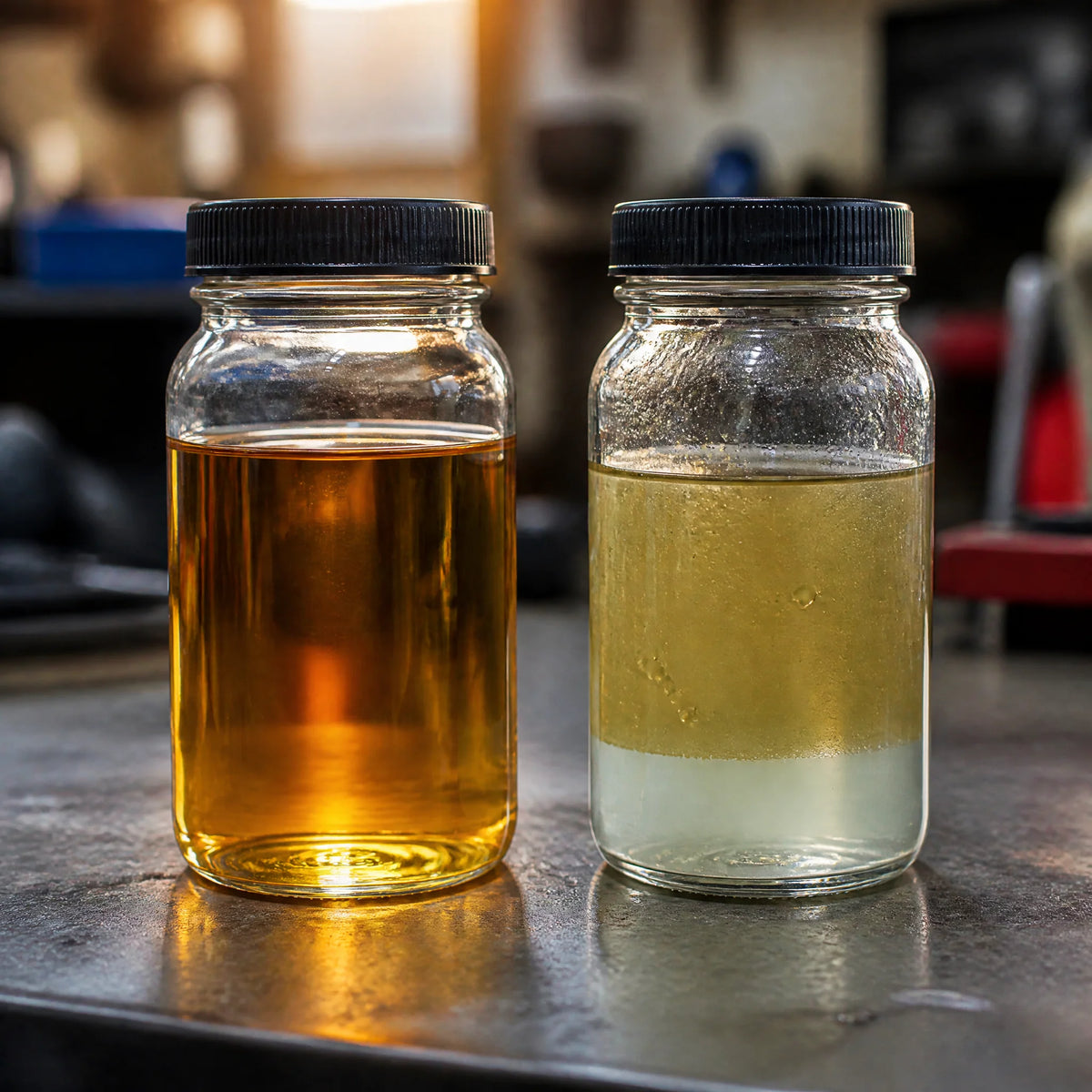
Your injectors do not fail because water "burns badly." They fail because water is a solvent, an abrasive and a catalyst at once, and a diesel fuel system is engineered on the assumption that it will see almost none of it. Water rusts and corrodes the steel around it, strips the lubricating film that diesel normally provides, then flashes into vapour inside the injector and implodes hard enough to erode metal when pressure returns. One tank of wet fuel can turn a set of injectors into scrap before the operator notices more than a rough idle.
This guide covers what water in diesel fuel does inside a fuel system, where it comes from, how to detect it early, and how separation equipment removes it before damage starts.
The six direct ways water damages a diesel fuel system
Filter manufacturer Donaldson, in its technical guidance on water in diesel, breaks the physical damage into six mechanisms. They rarely appear alone — one contamination event usually triggers several at once.
1. Rust
Iron and steel surfaces oxidise on contact with water. The rust particles then behave like any other hard particulate, circulating through the system and abrading precision surfaces. A rusty tank is not cosmetic; it is an ongoing source of abrasive debris.
2. Corrosion
Corrosion is one of the most common causes of injector failure. Water combines with acids already in the fuel to attack ferrous and non-ferrous metals, and the process accelerates once abrasion exposes fresh, unpassivated metal.
3. Abrasion from lost lubricity
Diesel lubricates the moving parts it passes through. Water has lower viscosity, so it provides less of a cushion between opposing surfaces. Metal-to-metal contact increases and clearances designed to meter fuel precisely begin to open up.
4. Etching
Water-induced fuel degradation produces hydrogen sulphide and sulphuric acid, which chemically eat metal surfaces and leave a roughened profile that traps debris and accelerates the next round of wear.
5. Pitting and cavitation
Free water flashes into vapour on hot metal surfaces, producing pits. Cavitation is the violent version: vapour bubbles collapse under sudden high pressure, and the droplets strike a tiny area with great force, causing surface fatigue and erosion. Inside an injector, that is metal being hammered away from within.
6. Spalling
Under extreme pressure, water forced into microscopic cracks decomposes and releases hydrogen in a micro-explosion. The cracks widen, wear particles are released, and the surface breaks up in flakes.
Free water can also freeze into ice crystals that behave exactly like hard particulate — wearing the system and, in larger volumes, blocking filters.
The indirect damage is just as expensive
Water also changes fuel chemistry.
- Soft solids. Water and many additive molecules are both polar. In the presence of free water, additives can disassociate from the hydrocarbon chain, combine with water and precipitate as a soft solid that clogs filters and forms deposits.
- Microbial growth. Bacteria and fungi need food and water. Free water lets them proliferate, producing slimes that foul fuel and acids that corrode the tank and fuel system.
- Fuel oxidation. Free water accelerates oxidation and encourages acids, gum and sediment — the degradation products that eventually end up in your filters.
Why high-pressure injectors fail first
Every part of a diesel fuel system relies on fuel for lubrication, but injectors rely on it most. Their internal surfaces are lapped to fine tolerances and are expected to meter fuel consistently for hundreds of millions of injection events. Replace that fuel — even briefly — with a fluid of poorer lubricity and the wear rate rises sharply, giving the erosion mechanisms above a fresh surface to work on.
So water damage presents as an injector problem even when the water entered through the tank — and by the time the injector smokes, the contamination event is long over. That is why replacement injectors and nozzles are usually the last line of defence, not a fix for the cause.
How water gets into diesel fuel
Contamination rarely has a single dramatic cause. Donaldson lists six common entry points: fuel already wet from delivery; free water drop-out when fuel exceeds its saturation point; condensation from thermal cycling, especially in partly empty tanks; leaks from rain, pressure washing or groundwater; atmospheric absorption through vents; and human error at poorly sealed caps and access ports.
Water exists in diesel in three forms: dissolved (invisible and usually harmless below saturation), free (droplets that separate and settle), and emulsified (fine droplets held in suspension). Only dissolved water is unavoidable; the other two destroy hardware.
Symptoms of water contamination
Water does not announce itself. These are the signals worth acting on:
- Rough running, misfire or a stumble under load
- Hard starting, or an engine that starts then dies
- White exhaust smoke that does not clear once warm
- Sudden power loss or derate
- A check-engine light with a water-in-fuel code — P2269 ("Water in Fuel Condition") is the generic OBD-II code used on many diesel applications, though not every engine reports water this way
- Cloudy or hazy fuel in a clear sample jar
- A separator bowl that fills faster than expected between drains
Cloudy fuel is the cheapest warning you will get. Clear, bright fuel that separates cleanly in a jar is what you want.
How much water is acceptable
Fuel standards do not demand zero water; they set a ceiling. Two reference points matter for most operators:
| Standard | Water limit | Notes |
|---|---|---|
| EN 590 (EU automotive diesel) | 200 mg/kg | Measured by EN ISO 12937 |
| ASTM D975 (US diesel fuel oils) | 0.05% by volume water and sediment | Combined water and sediment limit |
Those are limits for fuel as delivered. The real constraint inside your equipment is the saturation point, which Donaldson puts at roughly 50 to 1,800 ppm depending on temperature and biodiesel content. Warm fuel holds more dissolved water than cold — which is why free water can drop out overnight in a tank that was fine during the day.
Three practical ways to test for water
- Tank dip test. Water-detecting paste on a stick, lowered to the tank bottom. Fast and cheap; it finds free water only, but that is the fraction that does the damage.
- Inline sensors. Report dissolved water as a percentage of relative humidity in real time — good for continuous monitoring, less so for a one-off check.
- Karl Fischer titration. A lab test accurate down to about 50 ppm, and the reference method when you need a number rather than an indication.
How a fuel water separator actually removes water
Settling relies on water being denser than diesel: flow slows in a large bowl, droplets sink, and you drain them from the bottom. Coalescing uses media that forces fine droplets to merge into larger ones heavy enough to fall out of suspension.
Modern ultra-low-sulphur diesel complicates both. ULSD contains surfactant additives that interfere with coalescing media, and those surfactants make conventional separators markedly less effective at high flow rates. That is why the specification that matters most is not the micron rating but the flow rate the separator is rated for. Push 360 gph through a housing designed for 90 gph and you have not built a separator — you have built a pipe. It is also why housings carry a clear bowl and a drain: the bowl is not a filter but a settling chamber you are meant to look at.
Matching separator capacity to the engine
Our range shows the sizing logic directly:
| Model | Rated flow | Filtration | Typical use |
|---|---|---|---|
| 500FG series | 60 gph | 30 micron | Small generators, compact engines |
| 900FH30 | 90 gph (341 lph) | 98% @ 30 micron | Mobile filtration, CAT 900FG/900FH |
| 75-1000FHX | 360 gph | 30 micron (P) or 10 micron (T) | Marine generators, high-flow applications |
The 75-1000FHX, for example, is a twin-turbine assembly with a clear bowl on each unit, a six-way valve, a 15 psi pressure rating and a 30-micron element as standard, with a 10-micron variant available. If your engine's return flow is high — as on many common-rail systems — size the separator against total flow, not just consumption.
A routine that prevents most of this
- Drain the bowl on a schedule, not when you remember. Weekly on stationary equipment, daily on machines working in rain, mud or humidity.
- Look at what comes out. A few drops is normal. A steady stream means the problem is upstream — the separator works, but the source still needs fixing.
- Replace elements on condition and hours, always after a contamination event. A water-soaked element can pass water through.
- Keep tanks full to cut air space and condensation, and rotate fuel rather than storing it across seasons.
- Audit the tank annually. Sludge, rust and microbial slime at the bottom keep re-contaminating clean fuel.
Frequently asked questions
Does a standard fuel filter remove water? No. A particulate filter can capture droplets but not free water in quantity. You need a separator combining settling or coalescing with a drainable bowl — water-blocking media where the fuel must be genuinely dry.
Will a fuel additive fix water contamination? Additives can help with microbial growth or emulsified water, but they do not remove free water from a tank. Draining is the only reliable method for bulk free water.
How often should a separator bowl be drained? More often than most operators do it. Weekly is a reasonable baseline for stationary equipment; daily for machines in wet or dusty conditions.
Protect the injectors before they fail
Water is unavoidable in diesel. Injector damage is not. A correctly sized fuel water separator with a bowl you actually drain, elements you actually change and a tank you actually inspect will stop nearly every failure described here.
Browse our fuel system parts for separators, housings and replacement elements, or read the drain and replace procedure for a Racor separator before your next service. Already chasing injector symptoms? Start with the common symptoms of bad fuel injection and match the evidence before replacing hardware.


