
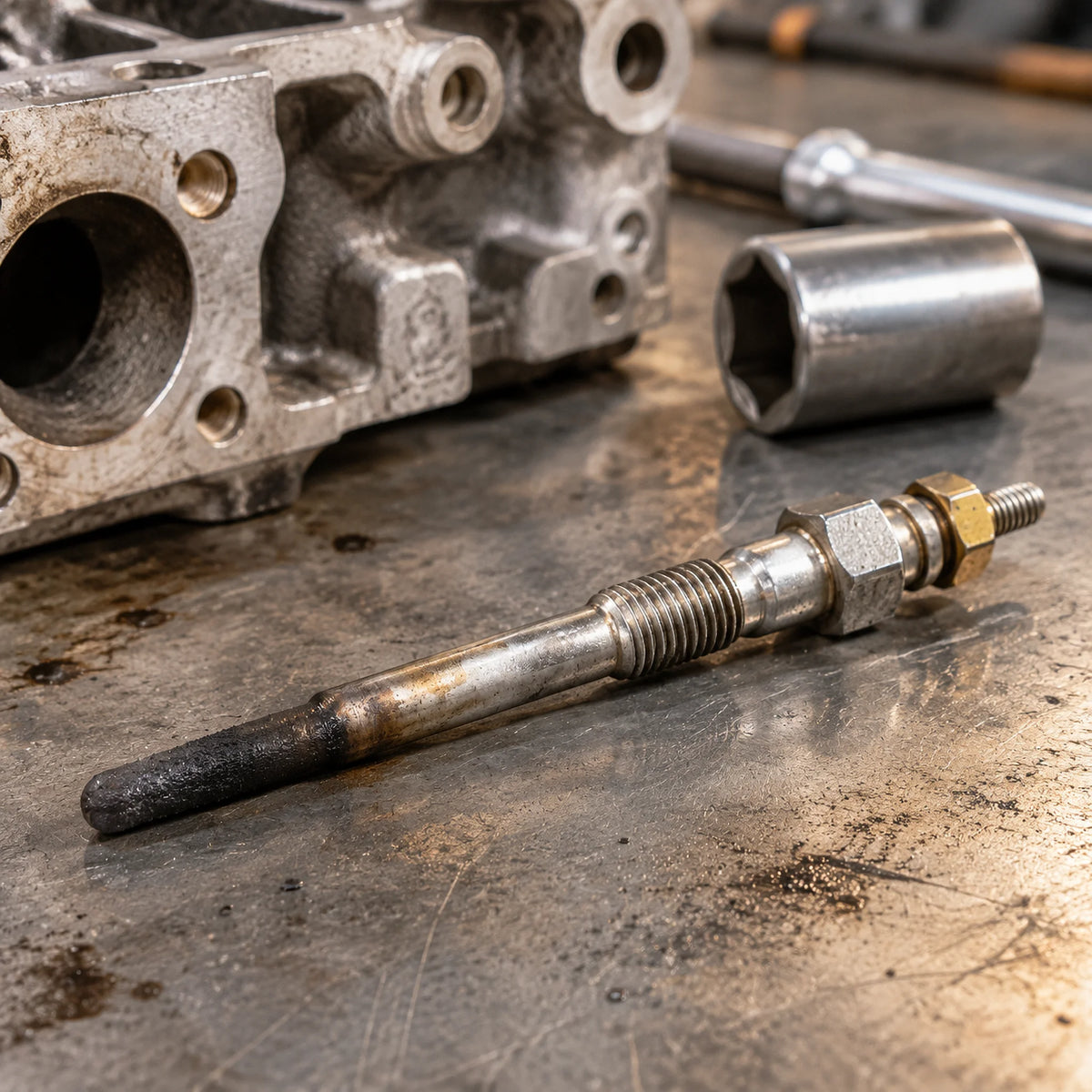
A diesel that cranks two or three seconds longer than it used to, coughs out a puff of grey smoke and then idles slightly rough — and repeats it the next cold morning — is showing the classic glow plug failure symptoms. Once warm, it fires on the first turn. That is exactly why the fault gets ignored until the first frost turns a slow start into a no-start.
Glow plugs are consumable heating elements, not sensors, and three healthy plugs hide a dead one for months. What follows covers the symptoms that hold up under test, the checks that isolate the failed plug, the faults that imitate glow plug failure, and the 12V versus 24V trap that destroys new plugs.
What a Glow Plug Does, and Why It Only Matters Cold
A diesel has no spark plugs; it ignites fuel by compressing air until it self-ignites, as explained in why diesel engines have no spark plugs. That works cleanly once the block is warm. On a cold morning the compressed charge loses heat into cold walls and pistons, and the first firings become late, weak and smoky.
Each cylinder carries one glow plug: a sheathed element that glows orange-red at the tip and pre-heats the air around it so the first injections light off properly. It is a cold-start aid, not a continuous heater.
Pre-glow and Post-glow
The control module runs two phases. Pre-glow happens with the key on and before cranking — why you wait for the coil light to go out. Post-glow keeps the elements energised a few seconds after the engine catches, smoothing cold idle and cutting the unburnt fuel that shows as white smoke. A module that ignores pre-glow and one that holds the elements on too long are two different faults in the same circuit.
Because the system only works below a temperature threshold, a warm engine proves nothing. Diagnosis has to happen cold.
Glow Plug Failure Symptoms: Five Signs That Hold Up
1. Longer Cranking Before It Catches
The first symptom is time. The engine needs more revolutions because some cylinders contribute nothing until heat builds. Count seconds from cold, not from a hot restart, and compare with the same machine last season.
2. White or Grey Smoke That Clears
Unburnt diesel from a cold cylinder leaves as white or light grey haze at start-up and disappears within a minute. White smoke that continues once warm is a different problem — usually injection quantity, timing or coolant — and blaming the glow plugs wastes parts.
3. A Rough First Minute at Idle
A stumble or shake right after start that smooths out as the block warms is a cold misfire. On industrial engines it is often felt as vibration through the frame rather than seen on a tachometer.
4. The Coil Light Stays On or Flashes
A glow indicator that stays lit after start, or flashes, means the module logged a fault. Cheapest symptom to read, easiest to ignore.
5. Starts Get Harder as Ambient Drops
A pattern that tracks morning temperature — fine at 15 °C, reluctant at 5 °C, refusing at −5 °C — follows pre-heat capacity almost exactly. A battery problem follows state of charge instead, and a fuel problem follows fuel quality.
Fault Codes: What a Scanner Tells You and What It Cannot
On light-duty OBD-II engines the glow circuit reports P0380 (glow plug/heater circuit "A") and P0670 (glow plug control module circuit), with per-cylinder variants in the same family. These confirm the system logged a fault and give freeze-frame conditions at the moment it set.
They do not tell you which plug failed. Generic scan tools cannot read individual plug status, because that lives in manufacturer-extended parameters. On off-highway engines — Kubota V-series, Perkins 400 series, Yanmar TNV, Caterpillar industrial — there is usually no generic OBD-II port at all, so the multimeter is not a shortcut but the primary tool.
How to Test a Glow Plug Properly
Step 1: Isolate the Plug
Engine cold and off. Remove the connector or the busbar link so each plug is electrically on its own. Testing through a joined harness bleeds readings between plugs and makes every number meaningless.
Step 2: Measure Resistance to Ground
Set the meter to its lowest ohms range and probe the plug terminal against clean bare metal on the block. Most plugs sit around 0.7 Ω; a healthy element commonly reads roughly 0.5–2 Ω, and inexpensive meters often display 1–2 Ω simply because they cannot resolve that low. Read OL or infinite and the filament has burned through — that plug is dead.
Step 3: Read the Pattern, Not the Single Number
Compare all cylinders. One plug at OL beside three healthy ones is a clean single failure. Three or four plugs reading OL together is almost never four simultaneous burnouts — it points at the supply side: fuse, relay, busbar or module. One plug far higher than its neighbours is degrading and will fail next.
Step 4: Confirm Supply Voltage
With the meter on volts, watch a plug terminal during pre-glow. Power should arrive while the coil light is on and drop away afterwards. No voltage at any plug means the circuit, not the plugs, is the fault. A plug that tests good but never receives power is a module or wiring diagnosis — and on engines using a separate timer module, that unit becomes the suspect. The Yanmar glow plug timer 129211-77920 is a typical example of a controller sold as its own service part.
What Actually Kills Glow Plugs
Heat-cycle wear. Every cold start heats and cools the element. This is normal end of life, and why glow plugs are maintenance items rather than lifetime parts.
A module that overdrives them. Elements held on too long, or fed the wrong voltage, burn out early. If a fresh set dies quickly, stop replacing plugs and diagnose the controller.
Carbon and soot fouling. Heavy intake or EGR contamination deposits carbon on the tip and insulates the element from the charge it should heat. A plug that looks intact, tests fine and still will not help cold starting is often coked rather than broken.
Wrong voltage or heat range. A 12V plug in a 24V system fails immediately — the Caterpillar 24V heater glow plug 462-2235 exists because those loaders run a 24V circuit. Mismatched heat range and unbranded elements fail far sooner than the specified part.
Contamination in the bore. Coolant past a gasket or oil entering the chamber attacks the element and shorts it.
Glow Plugs vs the Other Cold-Start Suspects
| Symptom pattern | Most likely cause | Quick check |
|---|---|---|
| Long crank only when cold, coil light on | Glow plug or glow circuit | Resistance and pre-glow voltage test |
| Long crank hot and cold, slow turnover | Battery, cables, starter | Cranking voltage and speed |
| Starts then dies, white smoke, rough | Air in fuel, gelling, filter restriction | Filter restriction, fuel cloud point |
| Even cranking, no fire, no smoke | Fuel shut-off solenoid, injection pump | Solenoid power during crank |
| White smoke that persists when warm | Injection quantity, timing, coolant | Coolant temperature sensor, timing |
Two deserve ruling out first on equipment that sits outdoors: waxed fuel and a weak battery. Both mimic glow plug failure symptoms on the season's first cold morning, and neither is cured by new plugs. Scheduled winter maintenance on excavators covers both.
Replace One Plug or the Whole Set?
Replace the set. The remaining plugs have absorbed identical heat cycles, access is the expensive part of the job, and mixed ages leave cold-start behaviour uneven. On light-duty road engines published guidance puts typical plug life around 100,000–160,000 km; on industrial engines life is better measured in cold-start cycles and seasons, so a set fitted before winter is cheaper than a no-start in January.
Getting Old Plugs Out of an Aluminium Head
Work on a warm — not hot — engine, soak the threads with penetrating oil and let it sit, then crack each plug loose and back it off in stages rather than forcing it out. Clean carbon from the bore before fitting the new plug, apply anti-seize sparingly to the threads only, and torque to the engine manual figure; these plugs need far less torque than their thread size suggests. Clear stored codes and confirm a clean cold start afterwards.
Matching the Right Glow Plug to Your Engine
Fitment is decided by engine family and voltage, not appearance. The glow plug collection carries these references, and the part number always beats a photo match:
| Engine family / machine | Part number | Voltage |
|---|---|---|
| Kubota V3307, V3307T, V3800, V3007 | 1G777-65510 / 1G772-65510 | 12V |
| Kubota D722, D902, D905, D1005, D1105, V1305, V1505 | 16851-65510 / 16851-65512 | 12V |
| Perkins 100/400 series, 403D-15, 404F-22 | 185366190 / TPN257 / 185366060 | 12V |
| Caterpillar 924H, 924K, C4.4, C6.6, 953, 963 | 462-2235 | 24V |
| Bobcat 753, 763, 773, S150–S185, Kubota V2203 | 6655233 | 12V |
| JCB 802.7, 803, 804, 8014, 8040ZTS, 8025CTS | 02/630157, 717/11700 | 12V |
| Cummins A2300 (Nissan G10/N16 base) | 4900224 | 12V |
If your machine is missing, start from the brand pages — Kubota, Cummins, Bobcat, JCB, Caterpillar — and cross-check the OEM number cast on the old plug before ordering. Where one engine family covers several ratings, confirm voltage first.
FAQ
Can I run with a dead glow plug? On a warm engine yes, since the plug plays no part in running. The risks are hard cold starts, prolonged cranking that punishes the starter and battery, and a broken tip dropping into a cylinder if the element disintegrates.
Why did new plugs fail again within weeks? Almost always the controller, the voltage rating or the heat range. Confirm the module's on-time and output, confirm 12V versus 24V, then confirm the part number supersedes correctly for your engine.


