
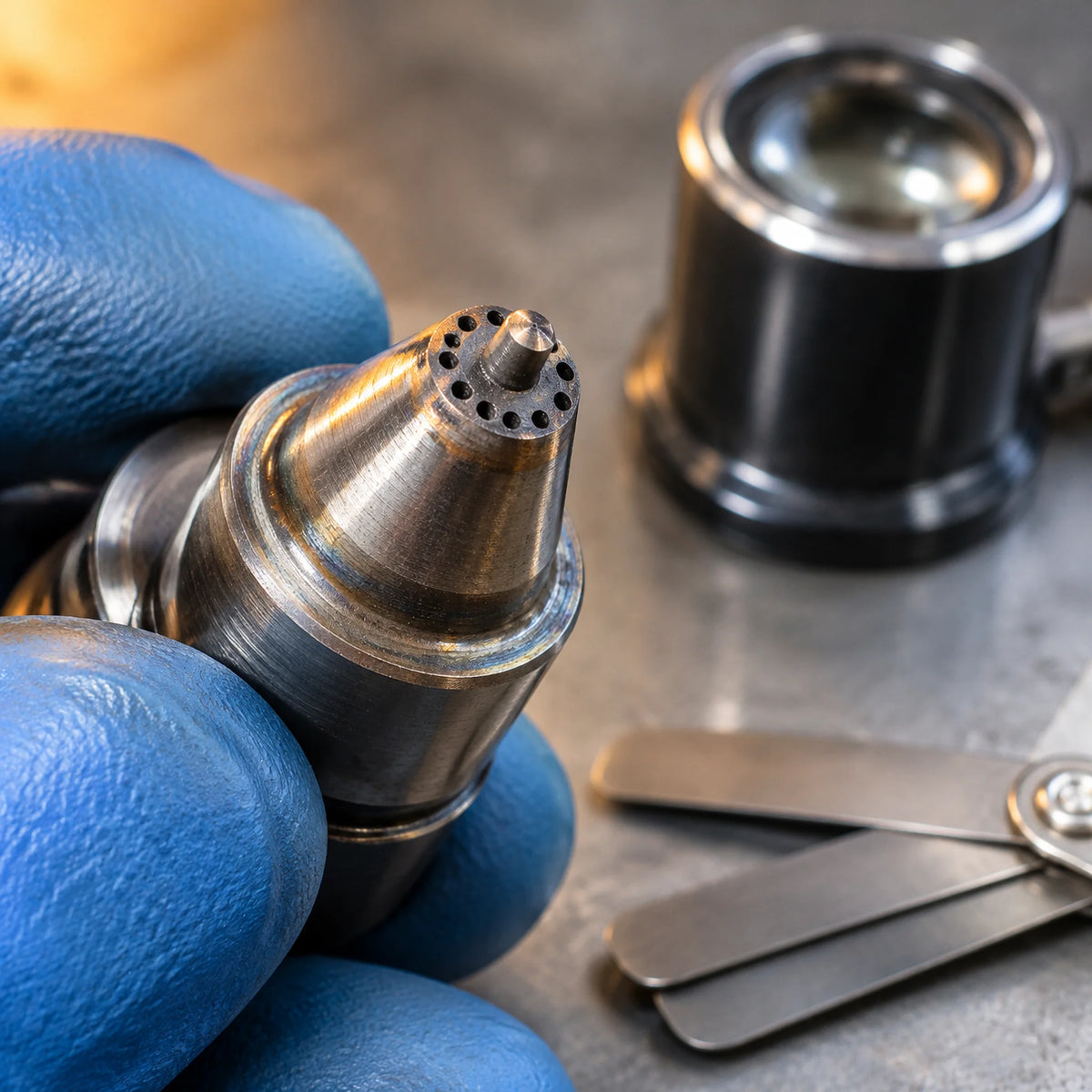
Diesel injector nozzle wear is a slow change in nozzle geometry, not a sudden breakdown. The needle lifts and seats millions of times, high-pressure fuel scours the spray holes, and abrasive particles that slipped past the filter quietly open the clearances. The engine keeps running, so nobody notices — until delivery has drifted far enough to show as rough idle, black smoke under load, or a fuel penalty blamed on the injection pump.
Wear and clogging are different failures with different fixes. A clogged nozzle is a cleanliness problem and often responds to cleaning. A worn nozzle is a dimensional problem, and cleaning never restores the spray holes. On common rail systems the ECU masks early wear by trimming quantity around the correction code, so the first symptom is often a code for a cylinder other than the one actually worn.
What Nozzle Wear Actually Is
The nozzle is the final metering element: its holes set flow area, its needle and seat control start and end of injection, its tip sets spray angle. All three degrade at different rates.
The needle seat cone. The needle slams onto this seat on every injection event. Impact fatigue creates a ring of micro-deformation that becomes a visible groove or polished band. Once the seat no longer conforms, the nozzle dribbles after the needle closes — white smoke when cold, black smoke and a hard knock once warm.
The spray holes. Hole edges round off under abrasive flow and the holes erode wider. Flow area scales roughly with the square of effective diameter, so a small dimensional change produces a disproportionate delivery change. Enlarged holes also weaken atomization: bigger droplets, later burn.
The sac and needle guide. Cavitation bubbles collapse below the seat; abrasives grind in the guide. Wear here shows as increased leak-off return flow rather than a changed spray pattern — which is why return-flow testing catches wear a visual check misses.
Six Wear Mechanisms and the Evidence Each Leaves
1. Abrasive Wear From Hard Particles
Silica, wear metals and filter-bypass debris act as lapping compound between needle and guide and across the seat. Clearances are measured in microns, so the system tolerates no particles in that range. Evidence: a dull, scuffed needle shank and a wide matte seat band instead of a crisp narrow line.
2. Needle Seat Impact Fatigue
Every opening and closing cycle is a small hammer blow. Over millions of cycles the seat work-hardens, then micro-spalls. Evidence: a visible ring groove, or a polished band wider than the original seat line. This is the mechanism most often behind post-injection drip while opening pressure still tests close to spec.
3. Cavitation Erosion
As fuel accelerates through the holes, local pressure falls below vapour pressure; bubbles collapse against hole walls and sac surfaces. Evidence: a roughened, pitted sac interior and sandblasted-looking hole inlets. Cavitation opens holes faster than abrasion alone and is common on common rail nozzles run at sustained high load.
4. Carbon Coking at Hole Inlets and Tip
Hot soak after shutdown bakes residue onto the tip and around the hole inlets. Evidence: hard black crust bridging the inlets or building a collar around the tip. Coking narrows flow and insulates the tip so it runs hotter — accelerating the mechanisms either side of it.
5. Corrosion From Water and Acidic Fuel
Water past the separator, or acidic compounds in aged fuel, attack needle and seat directly. Evidence: rust staining, a frosty etched needle, or a seat pitted instead of evenly worn. This is the mode that most often turns a repairable nozzle into scrap.
6. Thermal Overstress From an Overheating Tip
A coked or partly blocked nozzle runs hotter, and an overheated tip loses hardness. Evidence: blue or straw discolouration on the tip body, scale, sometimes a cracked or blistered tip. At this stage the nozzle is not worn — it is heat-damaged, and replacement is the only option.
Symptoms That Point at the Nozzle Rather Than the Pump
Worn nozzles and a tired pump produce overlapping symptoms; use the pattern to separate them:
- Black smoke only under load, normal idle — flow imbalance more than pump pressure loss.
- Rough idle that smooths above 1,200 rpm — one cylinder over-fuelling through an enlarged hole.
- Imbalance that moves with the injector — the fault follows the nozzle, not the cylinder.
- Rising leak-off return volume with no external leak — guide and seat wear.
- Hard cold start with white smoke, then improvement — seat leakage rather than hole erosion.
- Single-cylinder knock that stops when that injector is electrically disabled — confirms the cylinder, not the cause.
Check correction codes first: a cylinder that has drifted far from its siblings is a wear signal in itself.
How to Inspect a Nozzle Tip
Bench testing gives numbers; a close visual check tells you which mechanism you are facing. After external cleaning, inspect under magnification and record findings first:
- Wet tip, clean and uniform — seat leakage or needle sticking, not hole wear.
- Hard black collar around hole inlets — coking; cleaning may restore flow.
- Rounded, polished hole edges — abrasive erosion; cleaning will not restore flow area.
- Rough, pitted sac interior — cavitation; expect delivery to have drifted upward.
- Rust or etching on the needle — corrosion; replace rather than clean.
- Discolouration or scale on the tip body — thermal damage; replace.
For the full bench procedure — seat tightness, opening pressure adjustment, spray pattern on paper — see our guide to Cummins injector inspection. For in-service repair options, see fuel injector failure and how to repair it.
Identifying the Nozzle Family Before You Order
Part numbers are not interchangeable across families even when thread and body look identical. The prefix identifies the family:
- DLLA / DSLA / DCLA — throttle-type hole nozzles on many Bosch and Delphi systems; the suffix defines the hole configuration.
- DN0SD / DN0PD and similar — pintle nozzles for older indirect-injection engines.
- Pencil nozzles (4W7018, 4W7032, 0R8787) — long-body nozzles for Caterpillar 3406 and 3408 series.
- Denso 8-97xxxxxxx-6 format — OEM-format nozzles for Isuzu and other Japanese platforms.
Two nozzles with identical dimensions but different hole counts, diameters or spray angles both fit and both run — and one is wrong. Match the OEM number stamped on the old nozzle body, not an application description.
Common Platform References
Interchange references as printed on the corresponding WDPART listings; confirm against the part you remove.
| Nozzle / part number | Typical application | Family |
|---|---|---|
| 0433172203 | Bosch applications, Case, Cummins QSL9, Komatsu | DLLA-type hole nozzle |
| 4W7018 / 4W-7018 | Caterpillar 3406B, 3408, 3408B, 3432 | Pencil nozzle |
| 8-97609789-6 / 8976097896 | Isuzu 4HK1, 6HK1 | Denso OEM-format |
| 1G852-53002 | Kubota V2403 nozzle holder | Kubota |
| EJBR03101D / EJBR05102D | Delphi 1.5 dCi (Renault, Nissan, Dacia, Suzuki) | Common rail |
| 129506-53000 / DLLA150P234 | Yanmar 3TNE88, 4TNV88, 3D84 | Hole nozzle |
| MD603660 / 09340-05060 | Mitsubishi L2E, L3E, S3L, S3L2, S4L, K4N | Hole nozzle |
| RE36935 / RE36936 | John Deere 3029 DF/TF | Hole nozzle |
Wear Versus Contamination: Fix the Right Problem
Contamination is particulate or water in the fuel; the nozzle is a victim. Cleaning may recover it, and the fix is upstream: separator condition, filter intervals, storage hygiene — see cleaning injectors without removing them.
Wear is dimensional change in the nozzle itself. Cleaning changes nothing measurable; only replacement works, plus a check of what accelerated the wear — usually filtration or heat.
Rule: if the same cylinder's nozzle fails twice within one service interval, stop replacing nozzles and audit the fuel path.
Replace the Nozzle, the Injector, or the Whole Set?
- Nozzle only — practical on pencil-nozzle and nozzle-holder designs (Caterpillar 3406/3408, many Kubota, Yanmar and Mitsubishi applications) where the holder is sound.
- Complete injector — the realistic choice on common rail units with solenoid or piezo actuators and integrated correction coding. Re-tipping needs a bench, a new correction value and coding equipment most workshops lack.
- Whole set — right when measured delivery across the set has spread beyond tolerance, or hours are high enough that the remaining nozzles are close behind. One new nozzle beside five half-worn ones leaves the ECU balancing mismatched cylinders.
Always write the new correction codes (IQA/ISA family) into the ECU afterwards; skipping it reproduces the rough idle and smoke the new parts were bought to fix.
Preventing Accelerated Nozzle Wear
Almost every premature failure traces back to four things: filtration letting particles through, water reaching the nozzle, heat soak from a coked tip, and stale fuel. Address the separator and filters first — our fuel system parts range covers both. Keep seat washers and clamps correct, since a leaking washer cooks the nozzle from outside. Additive dosing keeps a clean nozzle clean but cannot restore flow area already lost.
Where to Source Replacement Nozzles
WDPART stocks over 600 fuel injector and nozzle listings across Bosch, Caterpillar, Cummins, Denso, Delphi, Kubota, Yanmar, Mitsubishi and John Deere platforms, each with a one-year warranty. Browse fuel injector and nozzle, or go straight to the Bosch and Cummins brand lines. Representative listings: 0433172203 Bosch/Case/Cummins QSL9, 4W7018 Caterpillar pencil nozzle, and 8-97609789-6 Denso for Isuzu 4HK1/6HK1. For whole injectors, see our Bosch fuel injectors overview.
Send the OEM number on the nozzle body plus the engine serial number, and we will confirm family, hole configuration and spray angle before you order.
FAQ
How long do diesel injector nozzles last?
There is no single service interval. Life depends on fuel cleanliness, filtration quality, duty cycle and fuel temperature far more than mileage. Condition-based replacement driven by return-flow and delivery testing beats a fixed hour count.
Can a worn nozzle be repaired?
On serviceable nozzle-holder designs, lapping the seat and fitting a new nozzle-and-needle pair is normal practice. On common rail injectors with integrated actuators and correction coding, the complete injector is replaced and coded to the ECU.
Does nozzle wear always cause a fault code?
No. Early wear is absorbed by cylinder balancing, so the engine drives normally and nothing is stored. It shows first as correction-code drift, and as a misfire or fuel-balance code only once the ECU runs out of adjustment range.


