
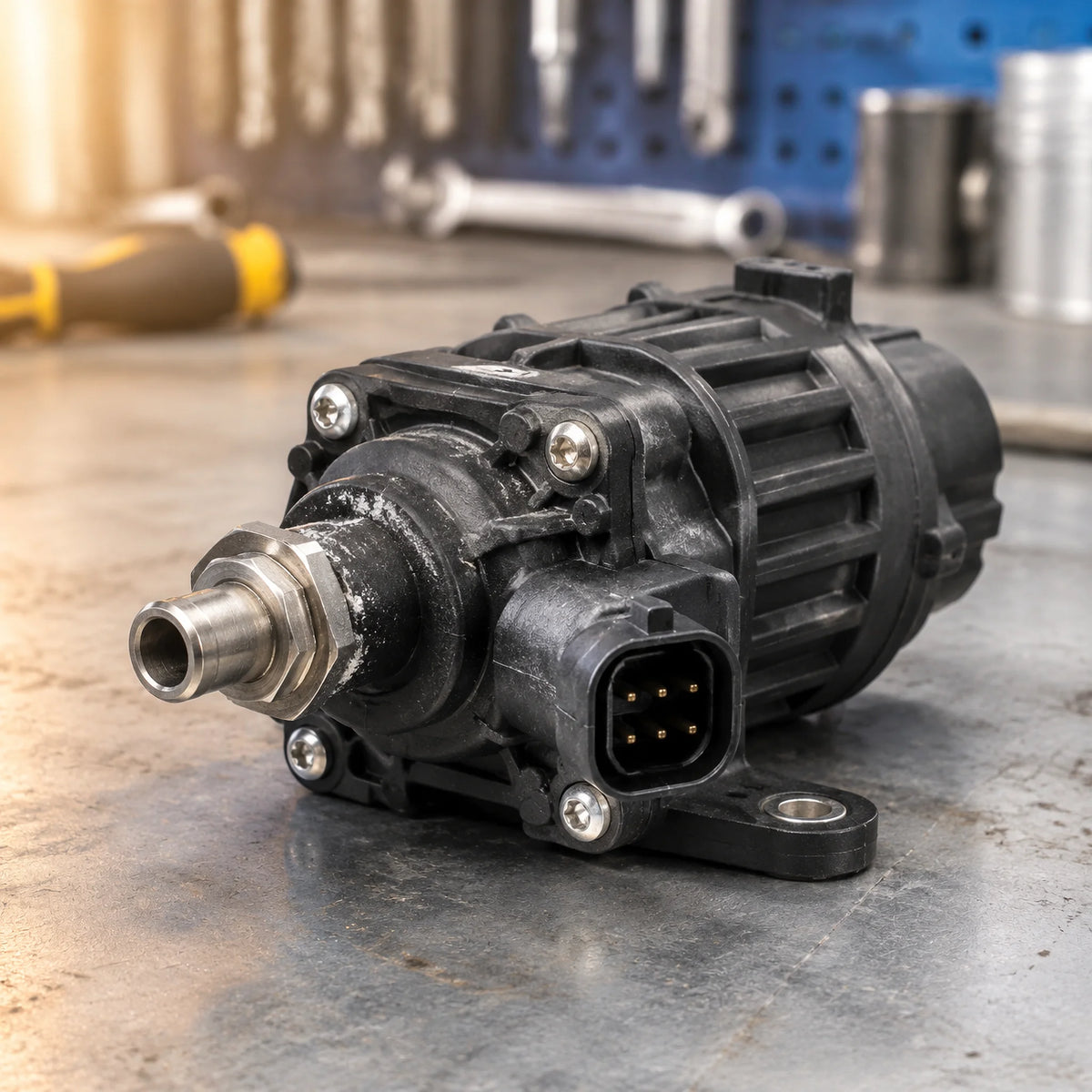
# DEF Doser Pump Failure Symptoms: 5 Warning Signs Your SCR System Is Failing
Short answer: A failing DEF doser pump usually announces itself with a P20E8 (reductant pressure too low) or P208A (reductant pump control circuit) code, a growing DEF bill, white vapour from the stack and an eventual torque derate. Before the code turns permanent, doser pump failure symptoms give three cheaper warnings — a crystallised dosing nozzle, a pump that primes more loudly than it used to, and an ammonia smell at idle. Confirm pressure and circuit behaviour with live data before ordering a replacement, because the pump is the part most often replaced for a fault that actually belongs to the nozzle, the wiring or the reagent itself.
What the DEF Doser Pump Actually Does
On a Cummins ISX/X15, ISB6.7, ISL or ISF running SCR, the dosing unit is a small two-stage pump. It draws DEF from the tank, pressurises it to a commanded value (broadly 5–6 bar depending on calibration and platform), and pushes it to an injector — the doser — threaded into the exhaust ahead of the catalyst. The ECM calculates how much reagent the current NOx load needs, then commands the pump to build the pressure that makes that dose possible.
That position in the system is exactly why dosing faults get misdiagnosed. The pump sits between a NOx sensor that people blame first and a nozzle that people blame second. When the pump can no longer build a clean, repeatable pressure pulse, the injector sprays a poor pattern, the SCR under-converts NOx, and the ECM logs an efficiency fault that reads like a sensor problem. Chasing that fault with sensors and catalysts is how a small repair becomes an expensive one.
Supply and pressure are separate stages, and the codes usually tell you which one is failing.
5 Warning Signs Your Doser Pump Is Failing
1. P20E8 — Reductant Pressure Too Low
P20E8 is stored when the ECM detects insufficient pressure in the reductant injection system between the pump and the nozzle. In the field this is the signature code of a worn dosing pump: tired internal seals, a clogged filter screen, or a unit that primes but bleeds pressure off between dosing events. It is also the code most often misread as a nozzle fault. If a new injector does not clear P20E8, the pump was the problem all along.
2. P208A and P2047–P2049 — Pump and Injector Circuit Codes
P208A is a reductant pump control circuit fault: the ECM commanded the pump and did not get the response it expected. P2047, P2048 and P2049 cover the reductant injector circuit — open, low and high respectively. Circuit codes always earn a wiring inspection before any part is ordered. Look for a harness chafed against a heat shield, corrosion or coolant residue in the connector, and a scorched pigtail caused by an exhaust leak just upstream of the doser.
3. Crystallised Urea Around the Dosing Nozzle
DEF is roughly one-third urea and two-thirds deionised water. When a dose is not fully atomised, or when the engine shuts down with reagent still on a hot nozzle, the water flashes off and leaves a hard white crust. A light film is normal; a rock-hard collar that narrows the spray cone is not. Cause and effect matter here: a crusted nozzle can be cleaned, but if the pump delivers an unstable pressure pulse, the crust comes straight back.
4. DEF Consumption That Stops Making Sense
Two opposite readings both point at the pump. Consumption well above the fleet average usually means the pump cannot hold commanded pressure, so the ECM keeps correcting and dosing more reagent than the route requires. Consumption dropping to almost nothing — a tank that stays full across long runs — often means the pump has stopped delivering entirely while the level sensor keeps reporting normally. Pull DEF pressure against commanded pressure at steady cruise; a healthy pump holds within a narrow band, while a failing one oscillates or sags on every dosing event. Consumption data is often the first of the doser pump failure symptoms you can actually measure.
5. Derate, White Vapour and a Sharp Ammonia Smell
Once aftertreatment faults exceed the calibration's fault-cycle allowance, the ECM cuts torque and limits road speed — the "5 mph derate" that puts a truck on the shoulder. Unburned reagent then shows as persistent white vapour and a sharp ammonia smell at idle: reagent is reaching the exhaust without being properly atomised or consumed.
Is It the Doser Pump, the Nozzle or the NOx Sensor?
This is the decision that costs money, so work outward from the cheapest check.
A NOx sensor problem shows up as a signal fault — codes in the P2200 family, implausible or frozen live data, and dosing that swings with the reading rather than the load. A crystallised nozzle restricts flow: pressure builds correctly but the spray pattern is wrong, and the crust is visible on inspection. A failing pump typically cannot reach or hold commanded pressure at all, and sets P20E8 or P208A while the nozzle looks clean.
If your fault list is heavy on sensor codes, our guide to making a NOx sensor last longer covers the signal side in more detail. If the codes point to pressure or the pump circuit, stay with this article.
How to Test a DEF Doser Pump in About 20 Minutes
- Read the codes and the freeze-frame. Note whether P20E8 appeared at key-on prime, at cruise, or after a regeneration — where it sets tells you which stage is failing.
- Command the pump with a scan tool. Run the prime or leak test routine. A healthy unit primes audibly and holds commanded pressure; a tired one primes loudly, loses pressure, or refuses to run at all.
- Watch pressure live data at steady cruise. Compare actual against commanded. A sag on every dosing event is a pump that no longer seals.
- Inspect the nozzle and the connector. Look for crust, a restricted spray cone, and green or white residue inside the plug.
- Check reagent quality. A refractometer should read about 32.5% urea. Diluted or contaminated DEF mimics a failing pump and costs nothing to rule out.
- Check supply volume. If the pump moves fluid but never builds pressure, the restriction is on the supply side — screen, line or tank pickup.
Bench-testing after removal is the cheapest confirmation: a unit that cannot hold pressure with no load is not worth refitting.
What Actually Kills a Doser Pump
- Contaminated reagent. A dirty funnel, an unsealed drum, or any fraction of diesel in the DEF tank attacks seals and the pump's internal surfaces.
- Freezing. DEF expands as it solidifies below roughly −11 °C. A unit left full through a hard freeze can crack internally and will never hold pressure again.
- Exhaust heat soak. Long idling with a hot stack cooks reagent onto the nozzle and stresses the pump body.
- Low system voltage. A weak battery or a tired charging circuit makes the pump run slow and shortens its life.
- Plain wear. Internal seals and the check valve have a finite cycle count, so a high-mileage unit eventually stops holding pressure.
Which Doser Pump Fits Your Engine
Fitment is where most returns happen, so match on the OEM number rather than the engine family. These units are all in stock at WDPART with the interchange numbers shown:
| OEM / interchange numbers | Application |
|---|---|
| 5273337RX | Cummins 6.7L and 4.5L engines, NTA855-M410, KT19-M |
| 2871880 / 4387658 | Cummins AdBlue / DEF urea pump module with dosing fluid supply |
| A042P115 / 4328805 / 5303018 | Cummins ISL, ISF, ISBe, ISDe and QSB (24V) |
| 0444043009 / 0444043016 | Cummins ISX urea pump and injector dosing module |
| 5273338 / 4931694 / 1205710-KW100 / 08030200031 | Cummins M11 exhaust aftertreatment dosing pump (24V) |
| 5506453 / A061G329 / A061L204 / 5506856 | Cummins and Scania urea pump nozzle (24V) |
| 0444042082 | Bosch urea injection delivery module, 12V / 24V |
Photograph the old unit's label before ordering, and compare connector keying as well as the number.
Repair or Replace?
Dosing pumps are not generally a rebuild item. The seals and check valve that make the unit hold pressure are pressed in and matched to the housing, so a shop rebuild rarely restores the pressure curve the ECM expects — and the replacement costs a fraction of what a derate costs in missed deliveries.
The decision rule we use: clean the nozzle, verify the reagent, and fix any circuit fault first. If P20E8 or P208A returns after that, the pump is done. Replace it, reset the fault memory, and let the ECM complete its own self-test over the next few drive cycles — aftertreatment codes stay stored until that verification passes.
Quick Answers
Can I drive with a failing doser pump? Until the derate triggers, yes. Once torque and speed are limited, plan the repair rather than pushing it — the ECM will keep derating harder, and unburned reagent is actively working on your catalyst.
Will cleaning the nozzle fix a P20E8? Only if the nozzle was the restriction. If a clean nozzle does not clear the code, the pressure loss is in the pump.
Is a used doser pump worth fitting? Rarely. You cannot verify the pressure curve from a photograph, and a used unit that has seen a freezing winter is a coin flip.
Next Step
If your fault list points at pressure or the pump circuit, start with the doser pump collection — 18 urea and AdBlue dosing units for Cummins, Bosch, Volvo, Mercedes, Iveco and Scania, with OEM interchange numbers on every page. Working on the fuel side instead? See the Cummins parts range and our guide to fuel metering valve failures. Every order ships with OEM-spec interchange data, a 1-year warranty and a 2-hour response window.


