
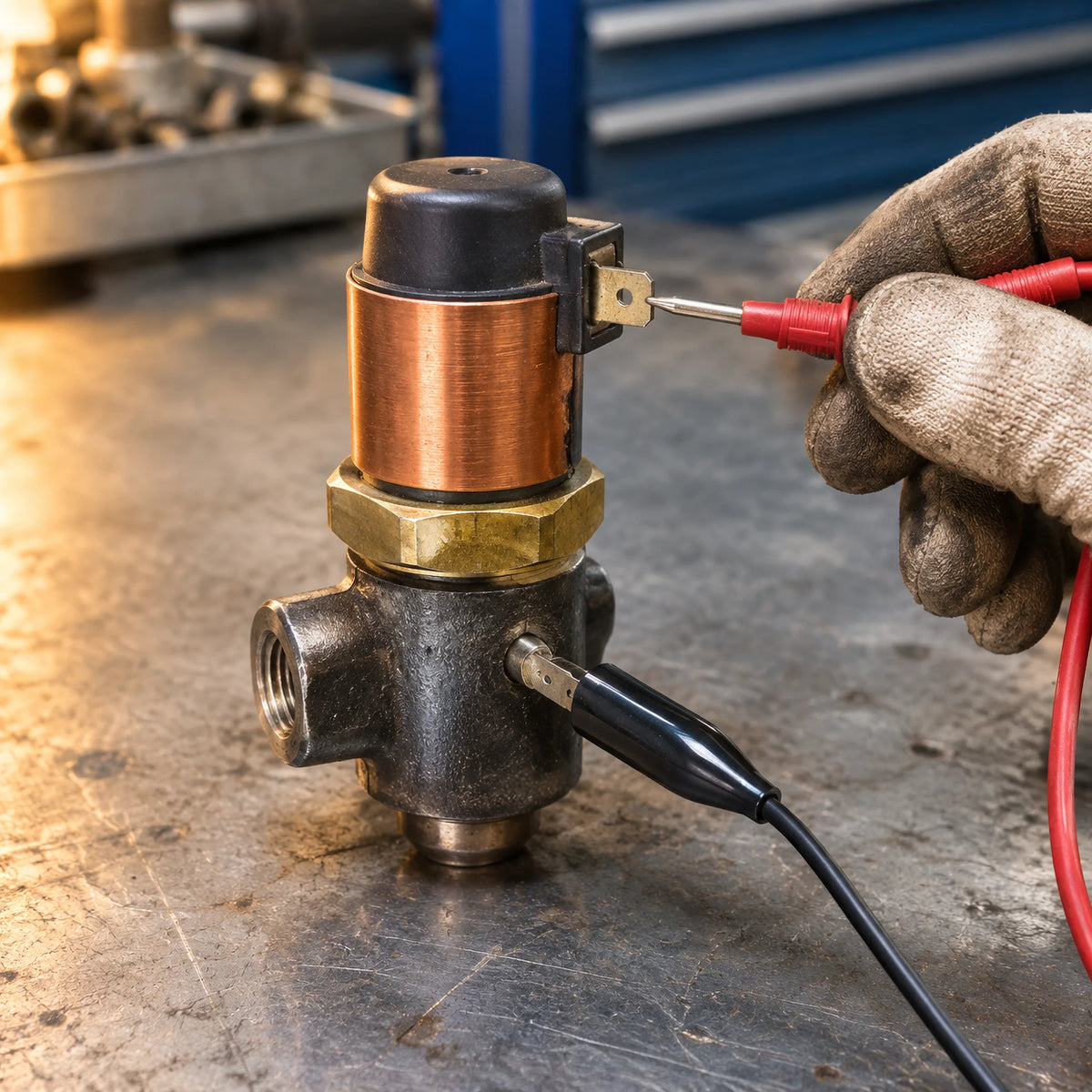
# How to Test a Cummins Fuel Shut-Off Solenoid (5.9L & 8.3L)
Short answer: To test a Cummins fuel shut-off solenoid on a 5.9L or 8.3L engine (B, 4B, 6B, 6BT, 6CT), cycle the key to ON and listen for a firm "click"; then disconnect the 2-pin connector and measure coil resistance with a digital multimeter (pull-in coil roughly 0.5–2 Ω, hold coil roughly 8–16 Ω against the common terminal — verify against your service spec), and finally bench-test the solenoid with a fused 12 V source to confirm the plunger pulls in and stays held. An open circuit in either coil, a stuck plunger, or a connector melted by heat means replacement — typically with a direct cross-ref unit such as 3935649 / 3936026 / 3935651 (SA-4764-12). Below is the complete professional procedure.
What a Cummins Fuel Shut-Off Solenoid Does
The fuel shut-off solenoid — also called the stop solenoid or shutdown solenoid — is a 12 V electric actuator mounted on the injection pump of mechanically governed Cummins B-series engines. When you turn the key to OFF, the ECM-equivalent circuit (or the ignition switch, on older mechanical pumps) de-energizes the solenoid, and a spring returns the plunger, moving the fuel shut-off lever to the "stop" position so the engine cannot run. On engines like the 5.9L (4B/6B/6BT) and 8.3L (6C/6CT), it is the only thing that physically stops fuel delivery — if it fails in the closed position, the engine cranks forever without firing; if it fails in the open position, the engine may not shut down.
The classic Cummins design uses two coils on a single bobbin: a low-resistance pull-in coil that snaps the plunger in, and a higher-resistance hold coil that keeps it energized. This two-coil design is exactly why a resistance test can locate most failures without removing the solenoid.
Symptoms of a Failing Stop Solenoid
These symptoms on a 5.9L/8.3L engine point to the fuel shut-off solenoid before anything else:
- Cranks but will not start — the most common symptom; no "click" is heard from the pump area when the key turns to ON.
- Starts after cooling down — the coil opens when hot (heat-soak failure) and reconnects as it cools.
- Stalls suddenly under load — intermittent open circuit from vibration or a corroded connector terminal.
- Will not shut off — the plunger is stuck or the hold coil is shorted to ground, keeping the lever in the run position.
- Burned connector smell — high resistance in the connector causes the classic melted 2-pin plug.
If your engine shows a fault code instead (e.g., SPN/FMI related to the fuel system), see our Cummins SPN code list & diagnostic guide first, then return to the physical checks below.
Tools You Need
- Digital multimeter (DMM) with resistance and DC voltage modes
- Fused jumper wires (or a 12 V battery and two leads with an inline 10 A fuse)
- Wire brush / contact cleaner and dielectric grease
- Service manual resistance spec for your exact part number (or use the typical ranges below)
- A helper, or a long test lead to reach the connector from the cab
Test 1 — The Click Test (60 Seconds)
- Turn the ignition to ON (do not crank).
- Listen at the injection pump area, or hold a screwdriver to the solenoid and put your ear to the handle.
- You should hear one firm "click" as the plunger pulls in, followed by a quieter hold.
Interpretation: No click at all = suspect open circuit, bad ground, or no power at the connector. Click but the engine still will not start = the plunger may be moving but the shut-off lever is not traveling far enough, or the problem is elsewhere in the fuel system (see our diesel engine fuel system troubleshooting guide).
Test 2 — Power and Ground at the Connector
- Unplug the 2-pin connector from the solenoid.
- Set the DMM to DC volts. With the key ON, probe the harness side: you should see battery voltage (12.4–12.7 V on a charged battery) between one pin and the other.
- Check the ground path: probe the same pin to a clean chassis ground. More than 0.5 V difference indicates a bad ground or corroded harness terminal.
Interpretation: No voltage at the connector = check the fuse, the ignition relay, and the wiring, not the solenoid. This step alone solves a large share of "crank no start" calls on Dodge Ram pickups with the 5.9L — the same application the WDPART 3935649-style solenoid covers.
Test 3 — Coil Resistance (Multimeter)
With the solenoid disconnected:
- Identify the terminals: on the common Cummins 2-pin solenoid, one terminal is common (usually the larger or the marked one), one is the pull-in coil, and one is the hold coil — or both coils share the common and each has its own pin.
- Measure between common and pull-in terminal: expect roughly 0.5–2 Ω.
- Measure between common and hold terminal: expect roughly 8–16 Ω.
- Measure each terminal to the solenoid body: infinite (open) expected; any continuity to ground means a shorted coil.
Interpretation: An open reading (infinite) on either coil = the coil is burnt and the solenoid must be replaced. A reading far outside the ranges above also means replacement. These ranges apply to typical 12 V Cummins stop solenoids (3935649, 3936026, 3935651, SA-4764-12); always compare with your service manual when available.
Test 4 — Bench Test (12 V Pull-In and Hold)
This confirms the mechanical action, not just the winding:
- Remove the solenoid and clamp its body to a bench ground (or connect the body terminal to battery negative).
- Connect a fused 12 V lead to the pull-in terminal — the plunger should snap in hard.
- Move the lead to the hold terminal — the plunger should stay in with a lighter force; tapping the case should not release it.
- Remove power — the plunger should return with a clean spring action, not slowly or stuck.
Interpretation: Plunger does not move = mechanical seizure or burnt coil. Plunger returns slowly = worn return spring; replace the solenoid rather than risk a "run-on" engine that refuses to shut down.
Common Failure Modes on 5.9L / 8.3L Engines
| Failure | Signature | Fix |
|---|---|---|
| Open pull-in coil | No click; start attempted fails | Replace solenoid (cross-ref 3935649 / SA-4764-12) |
| Open hold coil | Click, then plunger drops out; engine dies after starting | Replace solenoid |
| Melted 2-pin connector | Burnt smell; intermittent start | Replace connector pigtail and solenoid |
| Stuck plunger / return spring | Engine runs on after key OFF | Replace solenoid immediately |
| Bad ground | Intermittent no-start, worse when wet | Clean ground; check harness |
Replacement Cross-References
The WDPART 12 V fuel shut-off solenoid covers the most common Cummins fitments:
| OEM / Cross-Reference | Application |
|---|---|
| 3935649 / 3936026 / 3935651 | Cummins 5.9L & 8.3L (4B, 6B, 6BT, 6C, 6CT), Dodge Ram diesel |
| SA-4764-12 | Universal 12 V stop solenoid replacement (2-wire) |
Always verify mounting style (two-bolt flange vs. bracket) and plunger stroke against your pump before ordering.
Frequently Asked Questions
Q: My Cummins 5.9L cranks but won't start — is it always the solenoid?
A: No. Check power at the connector first, then coil resistance. If the solenoid clicks and resistance is in range, move on to lift pump pressure, fuel filters, and the fuel shut-off lever linkage. The click test plus resistance test eliminates the solenoid in under five minutes.
Q: What resistance should a Cummins fuel shut-off solenoid read?
A: As a guide, the pull-in coil reads roughly 0.5–2 Ω and the hold coil roughly 8–16 Ω on 12 V units like 3935649 / 3936026. An open (OL) reading on either coil means the winding is burnt and the unit must be replaced. Verify against your service manual spec.
Q: Can I test the solenoid without removing it?
A: Yes. The click test and the connector voltage test are both on-vehicle. For the coil resistance and bench tests, remove the solenoid — on B-series pumps it is a two-bolt job that takes about ten minutes.
Q: The solenoid clicks but the engine still won't start. What next?
A: Confirm the plunger actually moves the fuel shut-off lever, check for a sticking lever on the pump, then check fuel supply — filter restriction and air ingress are common on these engines. Our diesel fuel system troubleshooting guide walks through the full sequence.
Q: Are aftermarket solenoids like SA-4764-12 reliable?
A: When sourced from an ISO-certified supplier, aftermarket stop solenoids are a standard, cost-effective repair used by fleet shops worldwide. The key is matching the coil voltage (12 V), mounting pattern, and plunger stroke to your pump — exactly what the WDPART 3935649/3936026/SA-4764-12 unit is cross-referenced for.
Conclusion
Testing a Cummins fuel shut-off solenoid on a 5.9L or 8.3L engine is a three-step job — click test, connector voltage check, and coil resistance — that any owner or mechanic can complete in ten minutes with a multimeter. If the coil is open, the connector is melted, or the plunger sticks, stop troubleshooting the rest of the fuel system and replace the solenoid first: it is the cheapest and most common fix for the "cranks but won't start" complaint on B-series Cummins engines.
Need a tested replacement? Shop the Solenoid Collection at WDPART or go directly to the 12V Fuel Shut Off Solenoid 3935649/3936026/SA-4764-12 for Cummins 5.9L & 8.3L — OEM-spec, thermal and vibration tested, with fast global shipping.
*About WDPART: WDPART supplies OEM-spec replacement diesel, agricultural, and construction equipment parts — fuel filters and water separators, solenoids, radiators, diagnostic tools, injectors and more — with factory-direct pricing and a 1-year warranty. Related reading: Detroit Diesel engine fault codes, Case IH tractor fault codes.*


