
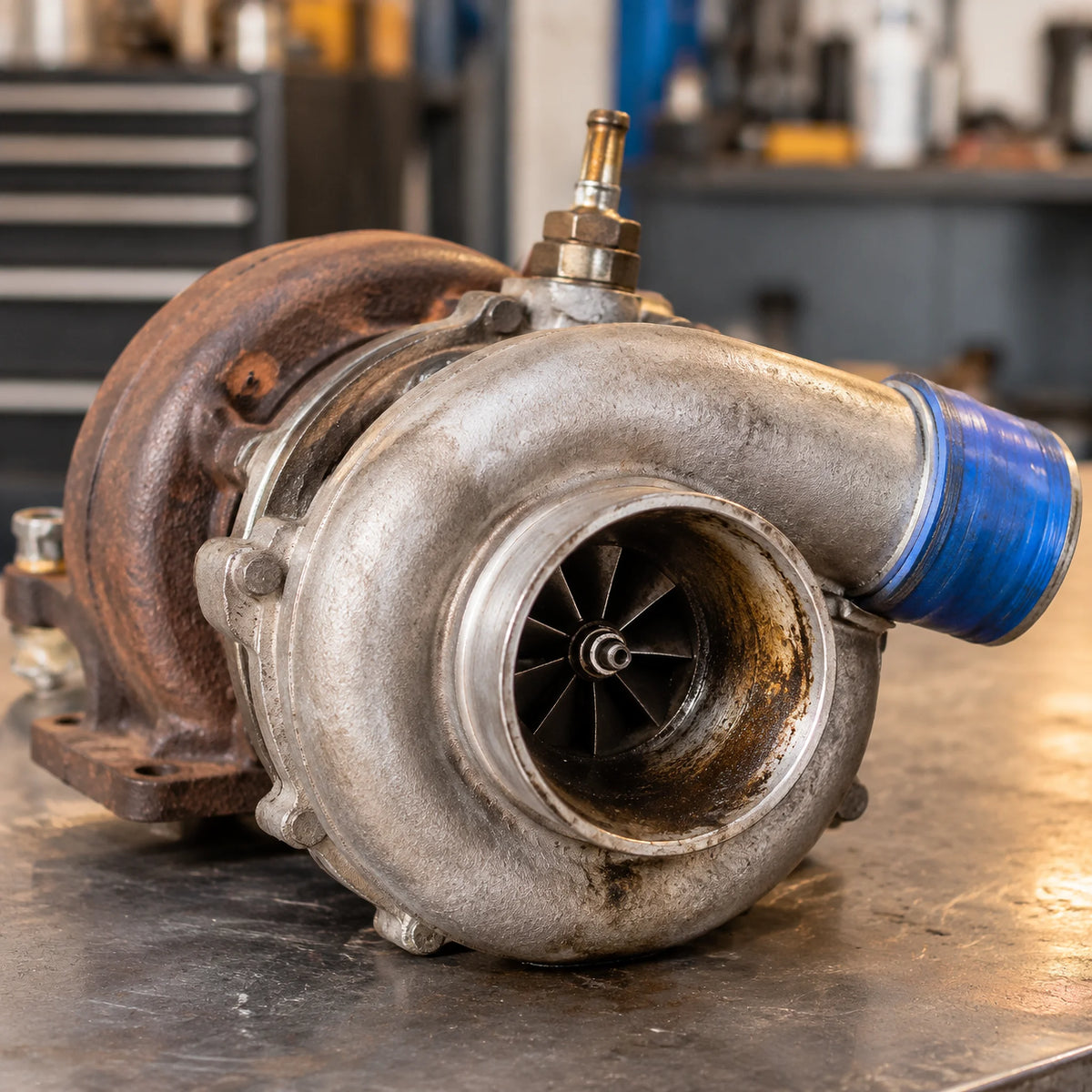
Most turbocharger failure symptoms fall into two families, separated by three observations: does the engine smoke blue or black, is there oil in the charge-air pipe, and does the shaft move when you test it. Blue smoke, oil in the pipe and radial shaft play mean the bearing housing has failed. Black smoke, a hiss and no shaft play mean the turbo is intact and boost is escaping downstream. Getting this wrong is expensive in one specific way — fewer than 1% of turbos fail from a manufacturing fault, while 95% fail from oil starvation, oil contamination or foreign object damage, so a new unit fitted onto the circuit that killed the first one usually dies too.
Turbocharger Failure Symptoms That Actually Narrow the Fault
Loss of boost with no unusual noise
The engine pulls cleanly off idle, then flattens above 1,500 rpm. No smoke, no whistle. This is the least specific of all turbocharger failure symptoms — a restricted filter, a collapsed intake hose or a seized VGT produces the same flat response. Check boost pressure against the commanded value first.
A whistle or siren that tracks turbo speed
A whistle rising and falling with turbo speed, not road speed, points to air escaping under pressure or the compressor wheel touching its housing. A leaking charge-air joint is cheap; wheel-to-housing contact grinds the wheel and feeds debris into the intake.
Blue or grey oil smoke
Oil smoke that is worse after idling and clears under load usually means oil is passing the turbine-end seal into the exhaust or the compressor-end seal into the intake. Check the charge-air pipe for pooled oil before condemning the unit — vapour mist is normal, a trickle is not.
Black smoke, high exhaust temperature, low power
Over-fuelling with too little air. On a turbo diesel that means boost is escaping between compressor and head: split hose, loose clamp, cracked intercooler tank, leaking manifold gasket. Black smoke is the signature of a boost leak, not a worn bearing.
Overboost, derate, or an actuator that will not hold
A turbo that spikes then derates, or an electronic actuator that hunts instead of holding a commanded position, points to the control side — sticking variable vanes, a failed actuator, or a sensor that no longer matches actual boost.
Oil Starvation and Boost Leak: Two Failures That Look Alike
A turbocharger can turn at over 240,000 rpm at exhaust temperatures around 950°C, with the shaft riding on an oil film measured in microns. Industry technical guidance is blunt about what happens when that film disappears: running a turbo without oil for five seconds is as harmful as running an engine without oil for five minutes, and insufficient lubrication can destroy the bearing system within seconds of operation.
| Observation | Oil starvation | Boost leak |
|---|---|---|
| Exhaust smoke | Blue / grey oil smoke | Black fuel smoke |
| Charge-air pipe | Oil pooling, intercooler wet | Dry, joint oily from blow-by |
| Shaft feel | Radial and axial play, possible wheel contact | Tight, no play |
| Boost behaviour | Falls away, often with noise | Reads low while turbo spins freely |
| Noise | Siren, scrape, rattle at idle | Hiss under load |
| Typical trigger | Blocked feed pipe, sludge, low oil, missed prime | Split hose, clamp, intercooler, gasket |
Documented starvation causes: low sump level, a kinked or carbon-blocked feed pipe, silicone breaking away from the oil inlet gasket, an incorrect gasket restricting supply, a blocked filter, a worn oil pump, failure to prime a replacement, and long cold-weather lay-ups. Strip-down shows excessive thrust and journal bearing wear, plus material transfer on bearing surfaces.
What the Codes Told You — and What They Did Not
Where OBD-II boost codes exist, an underboost code (commonly P0299) and an overboost code (commonly P0234) are the usual entries. Neither names a failed component: underboost follows any condition leaving measured boost below the request — leaking charge air, a stuck-open VGT, a lazy actuator, a worn turbo. Overboost comes from vanes that will not open or a wastegate that will not release. Many industrial and marine diesels in this class report nothing through a generic scanner and simply derate; there the symptom pattern is the diagnosis.
A Twenty-Minute Check With the Turbo Still Fitted
Five checks separate turbocharger failure symptoms from tuning faults, all with the unit fitted.
1. Confirm it spins. With the engine off, remove the intake hose and turn the compressor wheel by hand. Free rotation with light drag is healthy; a wheel that will not turn or scrapes needs no further diagnosis.
2. Separate radial from axial play. Rock the wheel side to side, then push and pull along the shaft axis. Small radial movement is normal; what condemns the unit is contact between wheel and housing. Compare against the manufacturer's limit, not a forum number.
3. Prove the oil feed. Crack the feed pipe at the turbo and crank with fuel shut off. Weak flow means the fault is upstream — blocked pipe, collapsing filter or tired pump, covered in how oil pumps work. Fitting a turbo onto that circuit repeats the failure.
4. Pressure-test the charge air. Cap the compressor outlet, pressurise to a low safe value, and watch for leaks at hoses, clamps, intercooler tanks and manifold. One test resolves most "no power" complaints.
5. Read the actuator. Command the VGT or wastegate through a scan tool and watch whether the mechanism follows. An actuator that stays put while commanded is a control fault, not a bearing fault.
Why the Replacement Fails the Same Way
The most common avoidable outcome is a second failure within a few hundred hours, from procedural causes: a feed pipe left with carbon, silicone on the oil inlet gasket, a reused filter, a turbo fitted dry, or load applied before oil pressure reached the bearings. Clean or replace the inlet pipe, fit a new oil filter, prime the bearing housing until oil overflows at the drain, then idle several minutes before load. The installation notes cover priming and orientation order.
VGT, Electronic Actuators and Soot
Variable-geometry turbos add a failure mode fixed-geometry units lack: the nozzle vanes and the ring that moves them sit in the exhaust stream, where soot collects on surfaces that must slide. As the mechanism binds, the actuator works against rising resistance until it can no longer reach the commanded position — the driver feels a flat spot, then a derate.
Two failures look identical and must be separated. Carboned-up vanes require cleaning or replacement of the turbo. Vanes that move freely with an actuator that does not point to the actuator as the part to change — a 24V unit such as the Cummins HE400 / HE500VG / HE551 actuator 2839392 costs a fraction of a complete turbocharger.
Cartridge, Actuator or Complete Unit?
| Condition | Replace |
|---|---|
| Shaft play or seal leakage, housings and wheels serviceable | Cartridge, e.g. H2C 3519092 for Cummins LTA10 / L-10 |
| Vanes free, actuator dead or not following commands | Actuator only |
| Cracked housing, damaged wheels, corroded wastegate | Complete turbocharger |
| Unknown history on a machine that must run tomorrow | Complete turbocharger |
| Root cause unresolved (oil supply, filtration, contamination) | Nothing until the cause is fixed |
A cartridge suits failures confined to the bearing and seal assembly with healthy housings, wheels and wastegate. It is wrong when wheels have ingested debris or the actuator failed — the core problem stays in place.
Preventing the Next Failure
Three habits cover most of it. Keep the oil clean and the feed pipe clear — carbon starves the bearing whatever the dipstick says. Idle briefly before shutdown so the shaft is not left with heat-soaked, coked oil. After a lay-up, crank with fuel shut off until pressure builds instead of starting and loading.
If symptoms go beyond boost — rough running, misfire, hard starting — work through the diesel engine fault checklist and the fuel system troubleshooting guide before ordering hardware; injector and delivery faults imitate boost faults convincingly. For how the unit is built, see Turbochargers Direct in 2023.
Turbochargers and Parts in Stock
All part numbers below are listed with engine applications and current prices in the turbocharger catalogue.
| Part number | Fits | Price |
|---|---|---|
| HX35 3537132 / 3802770 / 3598176 | Cummins 6BT 5.9L, 4BT 3.9L | $369.00 |
| WH1C 3535833 / 3533320 / 3925740 | Cummins 6BTA, 6BT | $631.00 |
| GT25 711736-5001S / 2674A200 | Perkins 1104C-44T, 1104C-E44T | $559.90 |
| GT2052 02/202400, 02/202415 | Perkins 1004-40T, JCB 3CX / 4CX | $515.00 |
| 1918019 / 191-8019 | Caterpillar 3126, 3126B, 3126E, C7 | $1,300.00 |
| 1G574-17016 | Kubota SVL90, M105XDTC, M8540 | $249.00 |
| 762931-5001S / 32006047 | JCB 4.4L Dieselmax | $263.90 |
| T04B33 SE500252 / RE62773 | John Deere 6059, 6068, 6359 | $335.00 |
| 2839392 / 3787658 (24V actuator) | Cummins HE400, HE500VG, HE551, ISX15 | $878.00 |
| H2C 3519092 (cartridge) | Cummins LTA10, L-10 | $330.00 |
Brand ranges sit under Cummins parts, Caterpillar parts, Kubota parts and JCB parts, alongside lubrication system parts for feed-pipe work.
FAQ
Can I keep driving with a failing turbocharger? Only far enough to park it. A worn bearing can let the wheel contact the housing, and the debris goes into the engine. A boost leak is less urgent but keeps derating the engine.
How do I know it is the turbo and not the injectors? Check smoke colour and the charge-air pipe. Injector faults give rough running, idle misfire and black or white smoke with a dry circuit; a failing turbo gives oil in the pipe, shaft play, or boost that does not match the command.
Is cleaning a sticking VGT a permanent fix? Rarely on its own. Cleaning restores movement, but quick re-seizure means the pattern — long idling, low-load cycles — or a worn actuator is still there.
Match the part to the engine, prime before first start, confirm pressure at the feed. Every turbocharger failure traced through this sequence ends at a hose, a filter, an actuator or a bearing housing — knowing which one before the first bolt comes out is the whole job.


