
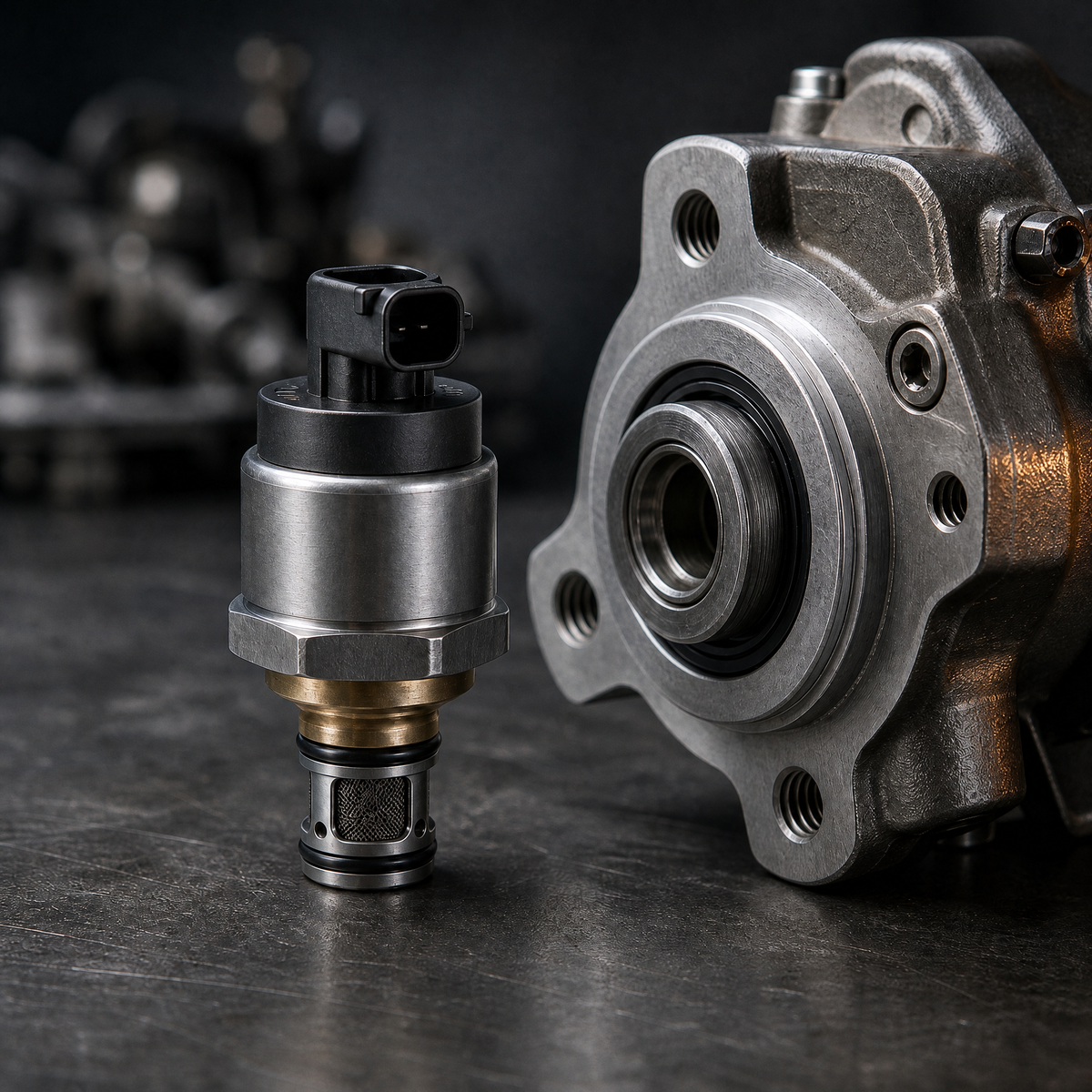
Short answer: A failing Bosch common rail fuel pressure regulator — also sold as a fuel pressure control valve, pressure control valve, or MPROP valve — normally shows itself in three ways: a long crank or hard start, a rail pressure that never matches what the ECU is asking for, and a sudden derate or limp mode, frequently logged as P0087, P0089 or P0191. On Bosch CP3 and CP4 pumps the coil itself is often still good; the usual culprit is debris or varnish blocking the valve screen. That is why a regulator can pass a resistance test and still be the fault. Confirm the diagnosis with live rail-pressure deviation data and a return-flow check before you spend money on parts.
What the Pressure Regulator Does on a Common Rail System
On a common rail diesel, the high-pressure pump does not decide the rail pressure — the ECU does. The fuel pressure regulator is the actuator the ECU uses to enforce that decision. It sits on the pump and continuously throttles the volume of fuel the pump is allowed to compress, so the rail can be held at the pressure the map demands at that moment: low at idle, very high under load.
Two families dominate Bosch applications. The first is the fuel pressure control valve fitted to CP3 pumps, which meters inlet fuel to the pump's high-pressure element. The second is the pressure control valve used on CP4 and later pumps, which works with the same logic but tighter tolerances and a smaller control screen. Both are current-controlled: the ECU varies amperage to move the valve spool against spring pressure, then reads back actual rail pressure from the rail pressure sensor. When the valve cannot hit the target, the ECU has no way to compensate except by shortening injection or cutting torque.
That closed loop is the reason regulator faults look like so many different problems. A regulator that is sticky, restricted or slow does not simply "fail" — it makes the whole fuel system behave inconsistently.
Why Bosch Pressure Regulators Fail
Metal debris from the pump
This is the most common failure path on high-mileage CP3 and CP4 units. As the pump's internal surfaces wear, fine metal particles circulate in the fuel and collect on the regulator's control screen. Flow is progressively restricted, rail pressure sags under load, and the ECU eventually derates the engine. If you find metallic sludge on the screen, the regulator is a symptom of pump wear, not an isolated failure — replacing only the valve will bring the fault back.
Varnish and contaminated fuel
Water and microbial contamination in stored diesel leave a varnish film on the valve spool. The spool then moves slowly or sticks, which shows up as rail pressure oscillation rather than a clean low-pressure fault. Water ingress is also the reason a water separator matters; skipping separator service on a machine that sits between jobs is a reliable way to end up here.
Solenoid, connector and wiring faults
Less common but easier to rule out: an open or shorted coil, corroded connector pins, or chafed harness. These produce hard electrical faults, not intermittent pressure drift, so they are found quickly with a resistance and voltage check at the valve.
Symptoms of a Failing Bosch Fuel Pressure Regulator
1. Long crank and hard starting
Rail pressure has to reach a minimum threshold before the ECU will fire the injectors. A regulator that cannot close fully bleeds pressure back to the tank, so cranking is extended, and on cold mornings the engine may need two or three attempts.
2. Rail pressure deviation and P0087 / P0089 / P0191
The defining symptom is a gap between desired and actual rail pressure. Live data typically shows actual pressure chasing the setpoint and losing, most visibly during a hard acceleration or a loaded pull. Common codes are P0087 (fuel rail/system pressure too low), P0089 (fuel pressure regulator performance) and P0191 (fuel rail pressure sensor circuit range/performance).
3. Derate, limp mode and sudden power loss
Once deviation exceeds a calibrated limit, the ECU protects the injection system by cutting fuel. The operator experiences it as a sudden power loss, a hard limit around a fixed rpm, or a limp-home mode that clears after a key cycle and returns under the same load.
4. Rough idle, surge and hunting
A sticky spool cannot hold a steady low-pressure setpoint at idle, so the rail drifts and the engine hunts. This is the symptom most often misdiagnosed as injector wear, because the rail pressure oscillation makes the injectors sound like the problem.
5. Fuel in the engine oil and a rising oil level
When rail pressure cannot be held, more fuel is returned to the tank and more finds its way past the injectors into the crankcase. A rising dipstick level with a diesel smell is a genuine warning sign, and it is a strong pointer toward a pressure-control problem rather than an injector fault.
6. Black smoke, poor economy and hot running
Under-fuelled-at-pressure combustion burns poorly. Owners typically report black smoke under load, a noticeable drop in fuel economy, and higher exhaust temperatures — all downstream effects of the same pressure deficit.
How to Confirm the Diagnosis Before Replacing Parts
Work in this order, because each step either confirms or eliminates the regulator cheaply.
- Read live data, not just codes. Watch desired versus actual rail pressure during a loaded acceleration. A consistent deficit that grows with demand points at the regulator or the pump's delivery, not at the sensor.
- Check the rail pressure sensor. A biased sensor mimics a regulator fault perfectly. Cross-check sensor voltage against a mechanical gauge if the deviation looks stable rather than load-dependent.
- Run a return-flow test. Excessive return flow with low rail pressure indicates internal leakage at the regulator or the pump.
- Inspect the control screen. Remove the valve and check the screen for metal or varnish. This single check separates "replace the valve" from "the pump is worn out and the valve is collateral damage".
- Test the coil and harness. Resistance and supply voltage at the connector confirm or clear the electrical side in minutes.
If rail pressure never rises even with the valve commanded closed, suspect the pump. If pressure rises but will not hold under load, and the screen is contaminated, plan on the pump as well as the valve.
Cross-Reference: Which Bosch Regulator Fits Your Pump
Regulators are matched to the pump and the application, not to the engine family alone, so use the OEM number on the original valve and the pump number together. Verified interchange numbers that appear across this family include 0928400642, 0928400646, 0928400682, 0928400700, 0281002863, and 4936097 on Cummins applications. Regulators marketed for control-valve duty and those sold as pressure-sensor assemblies are not interchangeable even when the part looks similar, so always confirm against the number stamped on the valve you are removing.
Matching the number matters for more than fitment. A valve with the wrong flow characteristic can be installed successfully and then produce rail pressure deviation of exactly the kind you were trying to fix.
Replacement Notes
Before fitting a replacement regulator, flush the pump inlet and replace the fuel filter — fitting a new valve into a contaminated system is how the same fault returns within a few hundred hours. Torque the retaining bolts to specification, use a new sealing ring, and clear the adaptive pressure values so the ECU relearns its control offsets. After the first start, confirm that desired and actual rail pressure track within the manufacturer's tolerance at both idle and full load.
For a step-by-step look at the wider circuit, the diesel engine fuel system troubleshooting guide walks through pressure, delivery and return paths in the same order used above. If the symptom set also includes injector knock or misfire, common symptoms of bad fuel injection covers the injector side of the diagnosis.
Where to Get the Right Regulator
WDPART supplies Bosch-compatible fuel pressure regulators and control valves for CP3 and CP4 applications, cross-referenced by OEM number so you can match the valve you are replacing. Browse the Bosch parts collection for regulators, pressure sensors and control valves, or start from the fuel system collection for pumps, filters and injectors. Representative parts include the 0928400642 / 4936097 fuel pressure regulator control valve for Bosch and Cummins and the 0281002863 fuel rail pressure sensor and pressure regulator for Bosch. Every part ships with a one-year warranty and a two-hour technical response.
Bottom line: if rail pressure chases the setpoint and loses under load, and the control screen shows debris, you are looking at a regulator that has been destroyed by the pump rather than a regulator that failed on its own. Fix the cause, then fit the valve.


